
The massive outer wall
The outer enclosure is built from large blocks of coralline limestone. Standing beside the wall gives a real sense of the size of the stones selected, moved and assembled by the temple builders.
One of Gozo's most remarkable prehistoric monuments and part of the UNESCO World Heritage property, the Megalithic Temples of Malta.
Rising from the Xagħra plateau, the Ġgantija Temples are an extraordinary reminder of the prehistoric communities that lived in the Maltese Islands more than five thousand years ago. The complex consists of two monumental temples built from enormous limestone blocks, enclosed within a massive outer wall.
Ġgantija is one of the places in Gozo where the scale of prehistoric construction is immediately apparent. The builders worked without modern machinery, yet created monumental buildings from huge blocks of local limestone. Some of the surviving stones are several metres long and form walls that still dominate the landscape today.
The temples belong to the Maltese megalithic temple tradition, a remarkable prehistoric building culture that produced some of the earliest monumental free-standing stone architecture known. UNESCO describes the Megalithic Temples of Malta as exceptional examples of prehistoric monumental architecture and recognises their outstanding universal value.
The outer enclosure is built from large blocks of coralline limestone. Standing beside the wall gives a real sense of the size of the stones selected, moved and assembled by the temple builders.
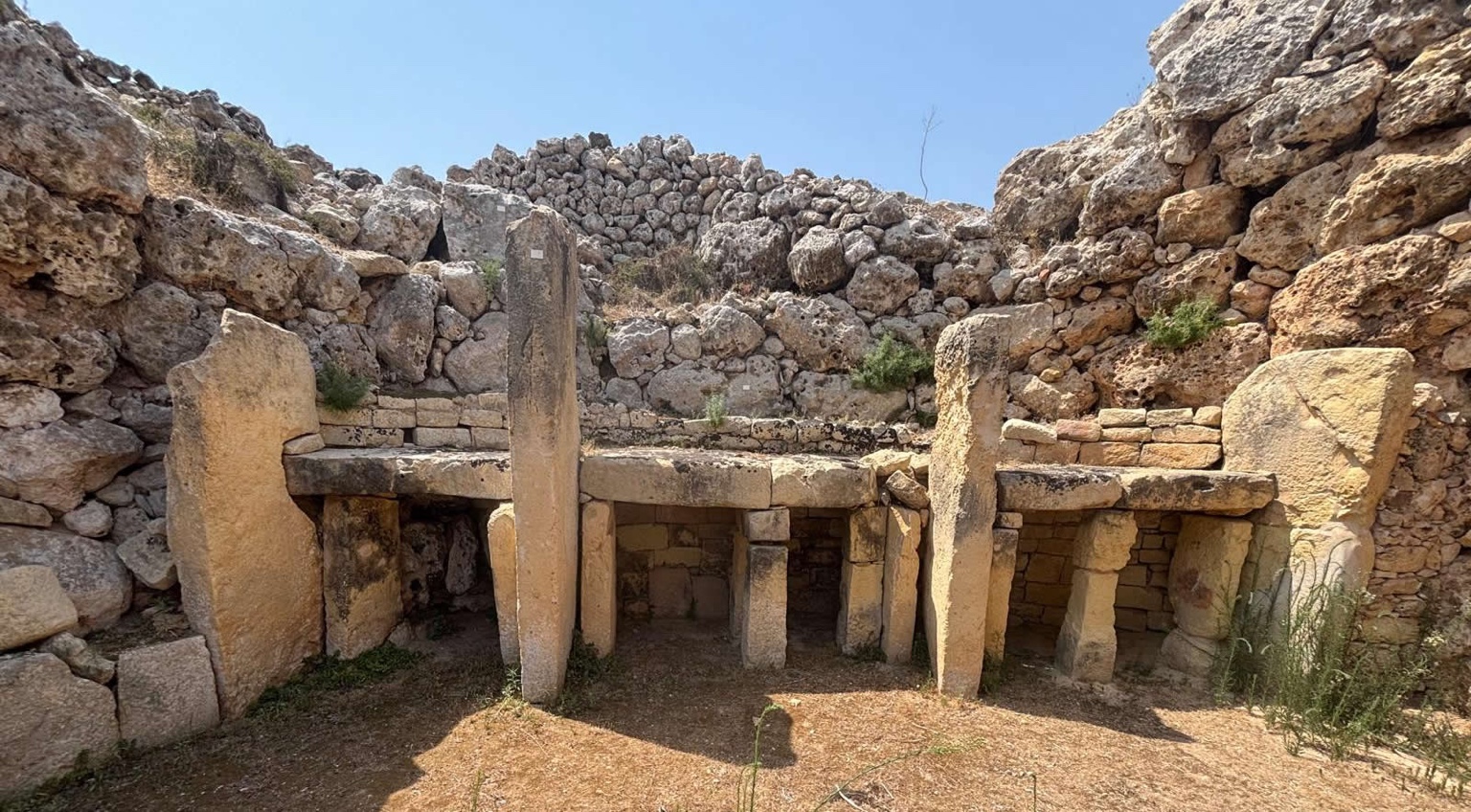
Within the ruins are apses, upright orthostats, thresholds and surviving architectural elements. The layout reflects the characteristic curving and apsidal design of Malta's prehistoric temples.
Ġgantija is made up of a southern temple and a northern temple. The southern temple is the larger and more complex of the two. Both were constructed using the same broad architectural tradition of apses arranged around a central axis, with substantial stonework forming the temple buildings and their enclosure.
The surviving structures are ruins rather than complete buildings, but enough remains to understand the monumental character of the complex. The entrance areas, internal spaces and massive walls reveal a carefully planned architectural scheme rather than a simple collection of standing stones.
The name Ġgantija is associated with the Maltese word for giant, reflecting the extraordinary size of the stones used at the site. The monument's scale has encouraged legends about giants, but its construction was the achievement of human communities with a sophisticated knowledge of stone, transport and construction.
UNESCO notes that the builders made use of locally available stone and understood its different properties. Harder coralline limestone was particularly suited to external walls, while softer globigerina limestone was used in more sheltered areas and for architectural and decorative elements.
The exact rituals carried out at Ġgantija can no longer be known with certainty. Archaeological evidence, however, indicates that the temples were important ceremonial places. Finds from Malta's megalithic temples include pottery, stone objects, figurines and other artefacts associated with ritual activity.
The architecture itself is also significant. The large forecourts, apses and carefully constructed entrances show that these were purpose-built monumental spaces, created by an organised society with the ability to mobilise considerable labour and resources.
Ġgantija was the first of Malta's prehistoric monuments to be cleared of accumulated earth and debris. The Xagħra Local Council records that Lieutenant-Colonel John Otto Bayer, Chief Civil Officer of Gozo from 1819 to 1826, undertook the operation at his own expense.
Archaeological investigation continued in later periods, helping researchers understand the sequence of construction and the relationship between Ġgantija and the wider prehistoric temple tradition of Malta and Gozo.
Ġgantija was the first Maltese prehistoric monument to be placed on the UNESCO World Heritage List, in 1980. In 1992 the World Heritage property was extended to include five other prehistoric temple complexes on Malta and Gozo and was renamed the Megalithic Temples of Malta.
The UNESCO property now includes Ġgantija, Ħaġar Qim, Mnajdra, Ta' Ħaġrat, Skorba and Tarxien. Together they demonstrate the extraordinary architectural and cultural achievements of Malta's prehistoric temple builders.


The site is managed by Heritage Malta and includes an interpretation centre and visitor facilities. Opening hours, admission prices and access arrangements can change, so it is best to check the official Heritage Malta information before travelling.
Address:
Ġgantija Temples, John Otto Bayer Street, Xagħra, Gozo
Approximate location:
36.04903° N, 14.26775° E
Ġgantija is close to the centre of Xagħra and is easy to combine with several other attractions in the area. The site is signposted from the main roads approaching Xagħra.
Ġgantija works particularly well as part of a northern Gozo day out. From the temples you can continue through Xagħra, visit the nearby caves and windmill, and then travel towards Ramla Bay and the north coast.
Information on this page is intended as a visitor guide. Historical interpretation and visitor arrangements may change as archaeological research and conservation work continue.